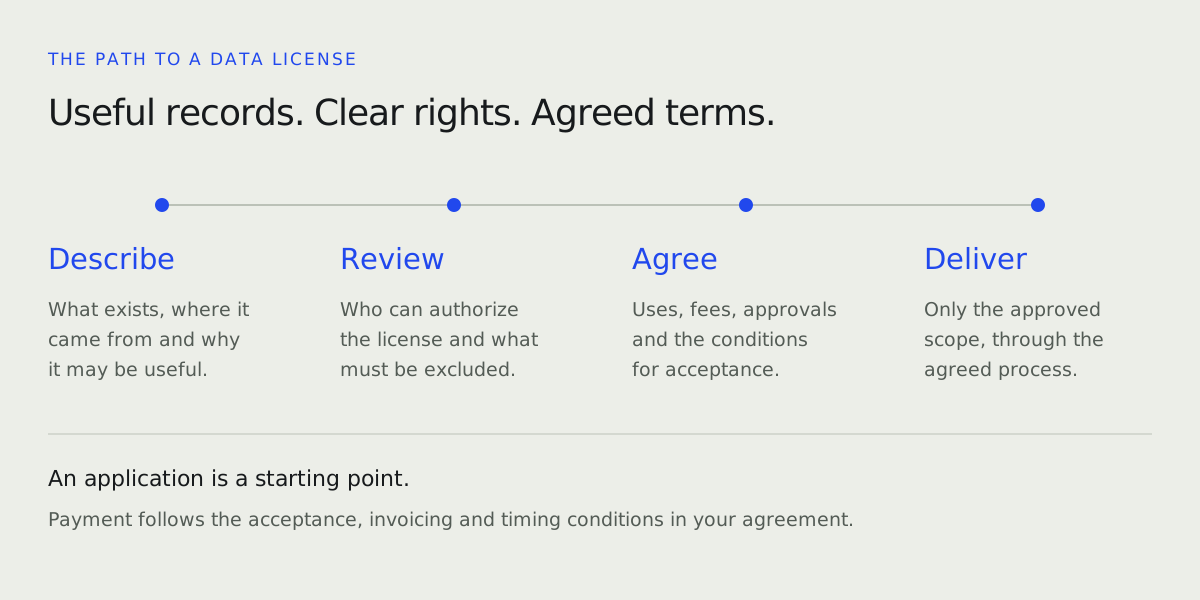
You may already have the raw material. Start by describing it.
The records behind everyday work can contain more useful context than a polished company presentation: how a problem was investigated, what changed during a project, or how a team reached a decision. Your first task is to identify a collection you can explain and take through the right internal review.
In this guide, “sell business data” means explore a paid license for agreed uses. It does not mean publish your archive or transfer every right you hold. A provider must still want the collection, and your company must be able to authorize the proposed arrangement.
Data Mining Masters helps you compare those routes. We do not buy your records, receive your dataset or confirm an offer. Applications and agreements take place directly with the selected provider.
If the business has already stopped operating, use the closed-company data partnership guide to review the separate program and trace who controls the records now.
1. Identify the workflow your records explain.
| Collection | Useful context to describe | Questions to flag for review |
|---|---|---|
| Support operations | Issue categories, conversations, actions and resolutions. | Customer material, personal information and attachments. |
| Sales and CRM | Lifecycle stages, linked activities and documented decisions. | Customer contracts, third-party records and export scope. |
| Projects and engineering | Task histories, revisions, issues and technical documentation. | Client work, source-code rights and confidential content. |
| Internal knowledge | Procedures, playbooks and how they were used or revised. | Authorship, licensed materials and restricted procedures. |
These are examples to investigate, not a list of automatically licensable assets. Give the collection a name, date range, format and approximate volume. Write down what links the records together and which parts you would initially exclude.
The data-readiness guide helps you assess the strengths and gaps. The brief builder turns that information into a document for internal review.
3. Compare partners that fit the collection.
| Route | Why investigate it | What to ask first |
|---|---|---|
| micro1 company-data program | Published criteria include 30+ full-time employees, mature operations and primarily English historical records. | Does this company and collection fit your current demand? What scope would you license? |
| Troveo business data | Describes licensing business records on the owner’s behalf with revenue shared across sales. | Which sales and later products count? What deductions, approvals and exclusivity terms apply? |
| Defined.ai Data Partners | A route to investigate for a separately described audio, image, video or text dataset. | Does the collection meet your marketplace’s data, metadata and rights requirements? |
Checked November 1, 2026 against micro1, Troveo and Defined.ai. Inclusion is not a recommendation to sign; eligibility and terms remain provider decisions.
If you have fewer than 30 full-time employees, do not assume that micro1’s published company-data route fits. Compare other routes using their current criteria. A provider’s lack of a fixed dataset-size minimum does not mean every company qualifies or every collection will sell.
For books or a publishing website, start with the licensing-route selector instead. Those assets have different application and payment models.
4. Apply with a brief that answers the obvious questions.
Make the first submission easy to assess. Explain the business activity, available period, approximate volume, formats, useful relationships and known restrictions. Identify the role that can coordinate approval and the next review step.
Use estimates honestly. “Approximately 20,000 tickets, attachment coverage still under review” is more useful than an exact-looking number with no basis. That is an illustrative description, not a qualification threshold.
Apply through the provider’s official process. Ask what happens next, what information is needed for discovery and whether the provider needs a schema or an approved sample. Keep a record of the collection you described so later scope changes are clear.
Ready to contact micro1? Start your company registration with micro1.
Referral link: Data Mining Masters may earn compensation for qualifying referrals. Commercial disclosure.
5. Compare the actual offer and delivery obligations.
An offer is a set of conditions, not just a headline amount. Compare the fee or revenue share alongside the records covered, permitted uses, recipients, duration, exclusivity, preparation duties and acceptance rules.
Ask who pays for export work and transformations, which deductions are permitted, and whether future updates are required. For revenue sharing, identify what counts as a sale, how it is reported and when your share is due.
Use the payment comparison example to see why the same percentage can produce different proceeds. Have the agreement reviewed for your circumstances before committing. Retaining ownership does not by itself define the rights you are licensing.
6. Deliver the agreed scope and track acceptance.
Keep delivery tied to the signed scope. Confirm the approved method, fields, period, exclusions and contact for handling questions. Record the version delivered and any changes requested during review.
Track submission, acceptance, invoicing and payment separately. A successful upload is not evidence of acceptance or payment. Ask how the provider handles incomplete or rejected records, and whether corrections change the review period.
micro1’s detailed FAQ describes a review period after transfer followed by invoicing and payment after approval. Confirm the applicable timing in your agreement; its page summarizes timing differently in different sections. Do not plan around a guaranteed date based on an application or upload alone.
Interactive checklist
Where are you in the process?
Check only the milestones you have completed. The next action is the earliest unfinished step. This checklist stays in this tab and does not submit information to a provider.
Questions business owners ask
How much will my company be paid?
Only a provider’s evaluated offer and agreement can answer that. Dataset characteristics, demand, licensed uses and payment model matter. Advertised ranges are not a valuation of your company’s records.
Can my company still use the data after licensing it?
Check the proposed agreement. Keeping underlying ownership and continuing internal use are important questions, but neither tells you all the licensed uses, restrictions or exclusivity obligations.
Is this the same as taking an AI training job?
No. Licensing an existing company collection is different from being paid to complete annotation or expert tasks. Some providers offer several programs, so confirm which one you are applying to.
What if no provider is interested?
Ask whether the issue is fit, rights, documentation or current demand. Improve a specific gap only when it makes practical sense. An unused collection does not have to become a licensing project.
Find a partner for the data you own.
Compare accepted assets, requirements and payment models before you apply.
Compare data partnersSources and approach
Provider information checked November 1, 2026. Examples, worksheets and preparation steps are Data Mining Masters’ editorial guidance. They are not firsthand transaction reports, provider approvals or legal advice.