Start with one archive you can explain
You can offer unused footage for AI training when you control the relevant rights and a buyer wants the material. Start with a bounded collection, document what it contains, resolve permission gaps, and agree on usage and payment before delivery. An upload is a submission, not a sale.
Choose one project folder rather than your entire storage system. A coherent archive is easier to describe, review and reconcile against a later licensing statement. Keep an untouched backup before you rename, trim or transcode anything.
Working example: a coastal field-filming archive
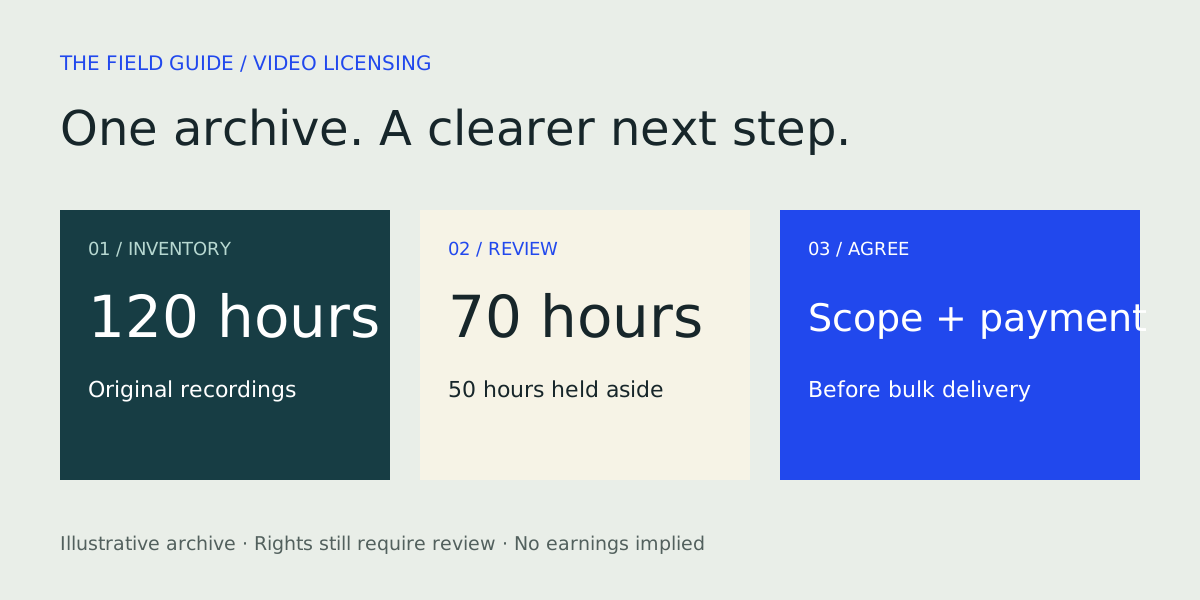
Imagine a videographer with 120 hours across 800 clips from 2022–2025: 70 hours of self-funded landscape and wildlife footage, 30 hours of client hotel shoots, and 20 hours of interviews. These are fictional planning numbers, not a real submission or earnings case.
Start the review with the 70-hour collection. Hold the hotel footage until the client contracts are checked. Hold the interviews until the participant permissions and proposed AI use are reviewed. Even the landscape collection still needs a check for people, restricted locations, third-party audio and existing licenses.
Give every clip a stable ID. Record duration, resolution, frame rate, codec, audio, capture date, subject, rights evidence and any exclusions. Count unique usable footage; three exports of the same shot are not three independent recordings.
Check ownership separately from releases
Possessing a drive or operating the camera does not settle who can license the footage. Check employment terms, production agreements, assignments and prior exclusive licenses before describing the archive as yours to sell.
In the United States, qualifying works made for hire can belong to the employer or commissioning party rather than the individual creator. The U.S. Copyright Office’s explanation distinguishes employee work from certain commissioned works covered by a written agreement. Other jurisdictions and contracts can differ; unresolved ownership needs qualified review.
| Check | Evidence to collect | Reason to hold a clip |
|---|---|---|
| Copyright ownership | Production contract, assignment, employment terms | A client or employer may control the recording. |
| People and voices | Relevant appearance or participant releases and agreed uses | The permission may not address the proposed training or related uses. |
| Locations and third-party material | Location terms; music, artwork and stock-element licenses | Permission for the original film may not cover a separate dataset license. |
| Existing obligations | Distribution, stock-library, confidentiality and exclusivity agreements | A new grant may conflict with an earlier commitment. |
A model release and copyright ownership answer different questions. Do not assume a standard release permits every AI use, or that removing a name resolves every concern. Flag identifiable people, minors, private conversations and sensitive settings for review. Ask the partner what documentation it requires for the specific deal.
For the sample archive, use three statuses in the manifest: ready for partner review, permission unresolved, and excluded. “Ready” records the work you have done; it is not a legal certification.
Preserve raw footage; deliver the agreed format
Keep camera originals, but confirm the recipient’s delivery specification before uploading terabytes. “Raw footage” can mean unedited source recordings; it does not necessarily mean a camera RAW codec. A buyer may request a particular encoded delivery file.
Troveo’s content-owner page lists video categories including documentaries, interviews, wildlife and aerial material, and expresses a preference for 1080p or 4K. Its onboarding documentation recommends transcoding to help processing. Neither point means every original file or codec will be accepted.
- Keep originals separate. Create a delivery copy. Retain filenames or a mapping back to the source clip IDs.
- Make an inventory first. Add actual resolution, frame rate, duration, codec, audio status and file size. Mark missing or uncertain metadata explicitly.
- Prepare a small review set. Select representative clips only after rights checks. Agree how the sample can be used; a review sample should not silently become a training license.
- Confirm transformations. Ask about trimming, watermarks, color grading, subtitles, audio removal and transcoding. Do not upscale footage to imply native 4K quality.
- Reconcile the transfer. Keep a file list, checksums where practical, delivery date and receipt. Distinguish uploaded, processed, accepted and licensed files.
Use our data preparation guide to turn the manifest into a broader dataset brief. Do not send client passwords, unrelated project files or an unrestricted drive link with the sample.
Define what the buyer may do with the footage
The useful commercial question is which rights you are granting, to whom, and for how long. Keeping copyright ownership does not by itself make the license narrow.
- Material: name the clip IDs, permitted audio, metadata and versions; list exclusions.
- Purpose: distinguish training, evaluation, research and other uses. Ask whether identity, face or voice-related uses are included or restricted.
- Recipients: clarify which buyers, affiliates or sublicensees can receive the files and whether onward transfers are allowed.
- Duration and exclusivity: specify the term, territory and any exclusive rights. Define whether exclusivity covers all licensing or only a particular channel or use.
- Retention and termination: ask what happens to delivered copies, future sales and models already trained if the relationship ends. Do not assume file deletion reverses completed training.
- Reporting: agree how licensed clips, fees, deductions and payment status will be reported.
In the working example, a starting proposal could cover only named coastal clips and their natural audio, with interviews and hotel footage expressly excluded. That is a negotiation brief, not a ready-to-sign contract. Compare the broader choices in our guide to AI licensing models.
Separate an upfront fee from future royalties
An upfront license fee is an amount agreed for a defined grant, payable at the milestone written into the contract. A royalty or revenue share depends on the agreed revenue base and trigger. An advance may be recoupable against future royalties, so it is not automatically extra money.
| Structure | What to clarify | What not to assume |
|---|---|---|
| Fixed license fee | Amount, accepted files, invoicing milestone and due date | That upload alone creates a payment obligation |
| Revenue share | Your percentage; gross or net revenue; allowable deductions; statements | That a percentage guarantees buyers or recurring income |
| Advance plus royalties | Recoupment, repayment conditions and when additional royalties begin | That the advance and all calculated royalties are additive |
Original arithmetic example—not Troveo pricing
Suppose a hypothetical contract allocates $6,000 to your footage, allows $1,000 in deductions, and pays you 50% of the remaining revenue. Your share would be ($6,000 − $1,000) × 50% = $2,500, before your own costs and taxes.
If you already received a $2,000 recoupable advance against that share, the additional payment would be $500, not $2,500. If a different contract pays 50% of gross revenue without those deductions, the share would instead be $3,000. The denominator matters as much as the percentage.
No universal per-hour price or guaranteed royalty percentage is established by the sources reviewed for this guide. Ask for the proposed economics in writing and evaluate preparation costs against the actual offer.
How the Troveo route works
Troveo is one route for licensing a video library. Its content-owner page describes an agreement and content survey, ingestion, preparation and licensing to AI buyers while the owner retains ownership. Review our Troveo profile before choosing the route.
The more specific Troveo payout documentation says uploading or ingestion generates no payment. Payment follows licensing, invoicing and receipt of the client’s payment; there is no fixed payout schedule, and not every clip is included in each deal. It identifies the portal’s Delivery and Earnings area for licensing and payment status.
Treat marketing about recurring royalties as an opportunity dependent on completed deals, not a monthly income commitment. Confirm your rate, deductions, exclusivity and timing in the agreement. This guide does not establish that Troveo will offer an upfront fee for your archive.
A sample archive brief you can adapt
Make the first conversation specific without sending the entire archive. Here is an original example based on the fictional collection above.
Coastal field footage · initial review brief
Collection: 70 hours of landscape and wildlife recordings across 2022–2025, selected from a 120-hour archive. Unique duration and final clip count will be confirmed after duplicate removal.
Files: Mixed 1080p and 4K camera originals, with codec, frame rate, duration and audio status listed per clip. Delivery transcode to be agreed; originals remain backed up.
Rights review: Self-funded productions. Existing licenses, locations and incidental people or audio are being checked per clip. Client hotel recordings and interviews are excluded from this proposal.
Proposed next step: Agree a review-only sample, technical specifications and an eligible clip list. Please specify the AI use, recipients, exclusivity, revenue base, deductions, reporting and payment trigger before bulk delivery.
Your first useful milestone is a documented collection a partner can assess. Start with one folder, keep uncertain material out of the initial scope, and expand only when the permissions and economics support it.
Sources and methodology
Primary sources checked November 7, 2026. Provider terms can change. The archive, brief and payment arithmetic are original illustrative examples; we have not submitted footage or verified a creator’s earnings. The rights checklist identifies questions for review rather than resolving a particular contract or jurisdiction.
- Troveo content owners — public video submission and licensing process.
- Troveo onboarding — ingestion, processing and portal access.
- Troveo payouts — payment conditions and licensing status.
- U.S. Copyright Office, Circular 30 — works made for hire and ownership.
The Troveo link is a direct official link. Some directory profiles carry separately disclosed owner-supplied referral links. Read our disclosure.