
The course will focus on the the knowledge and skills to select, apply and evaluate data science and big data analytics techniques to discover knowledge that can add value to a company. Students will gain both an in-depth theoretical understanding and practical hands-on experience, including implementing novel and emerging techniques. Participants will be kept abreast of current research and state of the art in data science related topics.
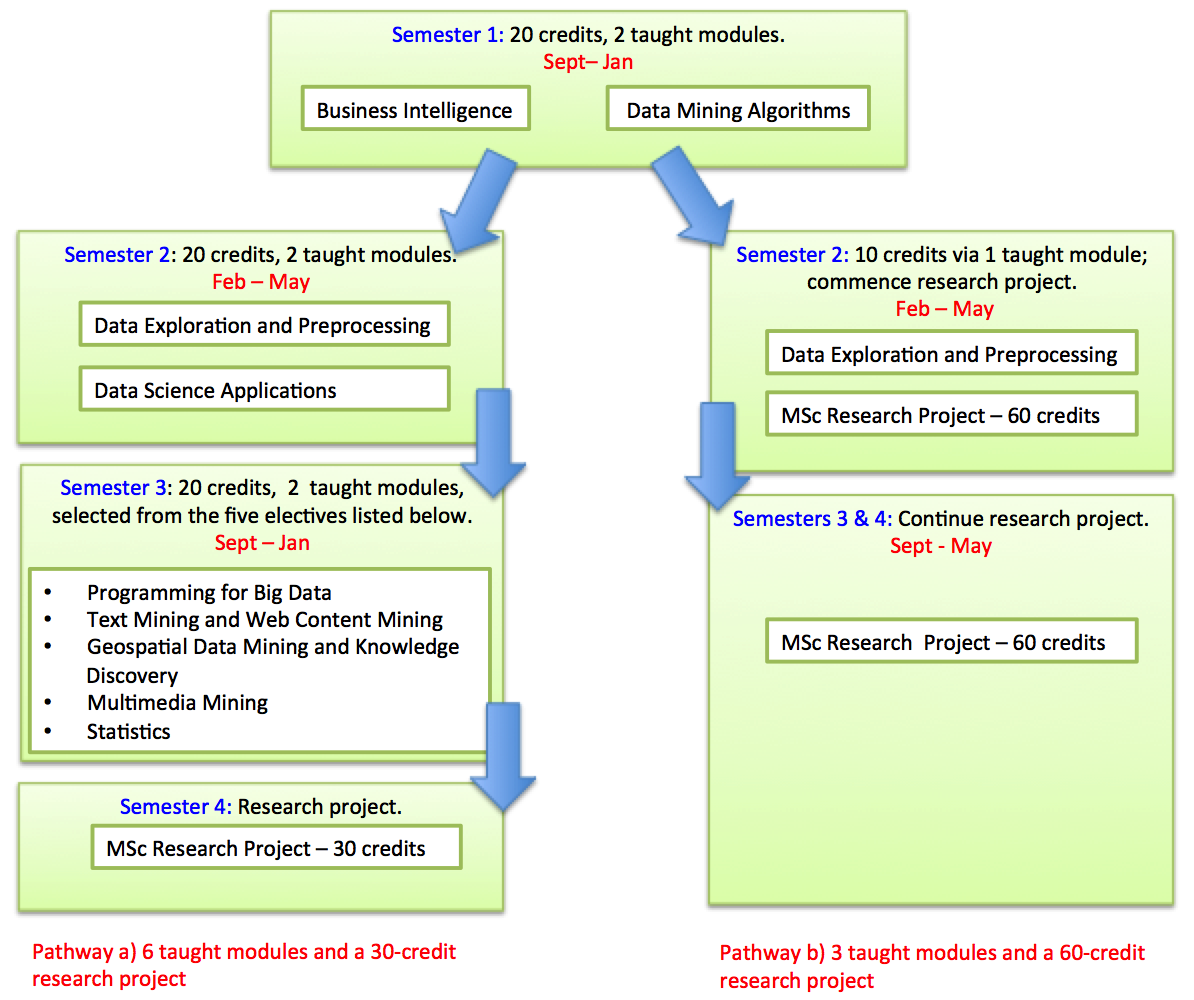
The two year programme is delivered over four semesters. There are two pathways as illustrated at the end of this page:
a) Complete six taught modules (two per semester) and a one-semester, 30-credit research project.
b) If you already have experience in data analytics, you may consider completing just three taught modules, and a 60-credit research project.
Details of the modules are given below.
You can listen to a video about the course here (14 mins), recorded in an Adobe Connect classroom.
|
Core Modules |
||
|
Semester 1 |
BI architecture, BI front-end, Data privacy and ethics; Business Intelligence and Data Mining methodologies, and the Business Intelligence life cycle. |
Standard Data Mining algorithms for descriptive modeling, classification, clustering, prediction, sequence analysis and association analysis. |
|
Semester 2 |
Data Pre-Processing and Exploration Data visualisation; Descriptive Statistics; Improving data quality; Transforming data in preparation for data mining; |
Business Intelligence and Data Mining Applications Project module: complete an analysis task to meet a business objective. |
|
Additional Electives, students can select two electives: |
||
|
Semester 3 |
Web Content Mining and Text Mining Natural Language Processing techniques to extract data from unstructured text. Mining data from unstructured text. |
Geospatial Data Mining and Knowledge Discovery Data Mining techniques and algorithms for mining data from Geographic Information Systems. |
|
The algorithms and challenges for processing large datasets; students will need fundamental knowledge and skills in computer programming. |
The learner will cover the fundamental ideas of probability and descriptive statistics, moving on to hypothesis testing and the design of experiments |
|
|
Data Mining techniques and algorithms for mining digital media content |
||
|
Dissertation: |
||
|
Semester 4 |
Research Project which can be industry based |
|
Module syllabi can be found here.